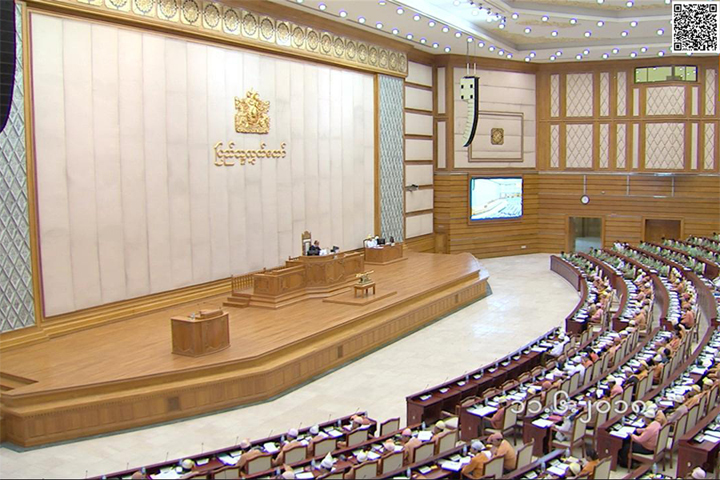
The Second Pyithu Hluttaw’s eighth regular session held its 14th day meeting in Nay Pyi Taw yesterday.
2nd Bill Amending Myanma Pearl Law
In yesterday meeting, Pyithu Hluttaw approved the 2nd Bill Amending the Myanma Pearl Law which was sent with amendments from Amyotha Hluttaw.
Boundary Line is official term; Zero Line, No Man’s Land are colloquial terms
MP U Maung Myint from Minkin Constituency asked the government why the state-run print media used the terms “Zero Line, Zero Line Area and No Man Land” and how the government planned to ensure there are no dwellings in the said zero-line area.
Deputy Minister for Information U Aung Hla Tun clarified the terms of reference used in the state-run print media regarding the boundary line.
It was found that the editorial team in the newsroom failed to correct the wrong usage in the news report on the Myan-mar-Bangladesh bilateral meeting of the border authorities held on 21 February 2018, said the deputy minister.
Following the incident, the ministry informed the stateowned and private media to use the official term of reference, “Boundary Line”, he said.
Besides, an article articulating the correct usage was published in the state-run media on 27 February 2018. He continued to say that Myanmar and Bangladesh signed the Demarcation of the Land Section of the Boundary, North of the Naf River on 12 November 1988, and paragraph 14 under Chapter 4 of the agreement said, “In order to make the boundary line easily identifiable and prevent the emergence of boundary line-intersected villages, neither High Contracting Party shall allow to build new houses or other structuresn of permanent or temporary nature, within a zone of 150 feet on each side of the boundary line.”
Being prohibited houses within a zone of 150 feet from the boundary line, local people use “No Man’s land” as colloquial terms, he said.
Deputy Minister U Aung Hla Tun continued to say that it is found that the land survey teams of the two countries also used the term “zero line” in order to make clear the difference between the 150-feet non-construction line and the Boundary Line, and the colloquial term “zero line” has hence become popular among the local people and land survey officials.
It is found that Myanmar and Bangladesh officials have been using the colloquial term at technical meetings for many years, he said, quoting the minutes of the meetings of the two countries held in 2006 and 2011.
The use of the colloquial term by the technicians cannot cause problems, but it can give rise to unnecessary complexities when the authorities and local people use the unofficial term, said the deputy minister.
Regarding the second part of the question, Deputy Minister U Aung Hla Tun replied that the Ministry of Home Affairs, Ministry of Foreign Affairs and the Rakhine State Government are working together in accordance with the existing laws to ensure there are no dwellings in the restricted areas.
Afterwards, MPs discusseda motion submitted by U Myint Thein of Wetlet constituency urging the Union Government to systematically collect unpaid tax revenue in a clear and transparent way.
Good practices, positive attitudes towards tax payments
U Tun Tun of Pwintbyu constituency discussed that good practices and positive attitudes towards tax payments need to be spread into the public. He said that instead of raising taxes it would be more beneficial to give tax awareness and education so tax evaders decrease and taxpayers increase. He said that Chapter (4)-Section (10) of the Customs Law states that the relevant ministry, in their task of tax collecting, can request aid and support from union ministries, state and region governments, and relevant authorities from self-administered zones to encourage taxpayers. U Tun Tun concluded by saying he approved the motion and wished for the swift development of the nation’s economy and the emergence of a positive tax payment culture.
The motion was further discussed by ten MPs.
Deputy Minister for Planning and Finance, U Maung Maung Win, explained that the Internal Revenue Department has been collaborating with international organizations to implement a modern tax administration system since 2012. The first phase of implementation was carried out from 2012-2013 FY to 2016-2017 FY. The second phase will be conducted from 2017-2018 FY to 2021-2022 FY with a focus on reviewing and amending laws related to taxes.
The deputy minister and MP U Myint Thein then submitted the motion to the Hluttaw for approval.
After a discussion amongthe assembly, Speaker U T Khun Myat then announced that the Hluttaw has approved of the motion.
The Speaker then announced that the Hluttaw approves the Second Bill to amend the Myanmar Pearl Law submitted by the Ministry of Natural Resources and Environmental Conservation.
Next, the Pyithu Hluttaw discussed the 2017 Bill amending the Vacant, Fallow and Virgin Land Management Law sent with amendments by the Amyotha Hluttaw.
The Speaker then announced the Pyithu Hluttaw’s approval of the bill. The fifteenth day meeting of the Eighth Regular Session of the 2nd Pyithu Hluttaw will be held tomorrow.
Reference: GNLM
June 15, 2018